Studio Praxis — Masterpiece Analysis
Pablo Picasso
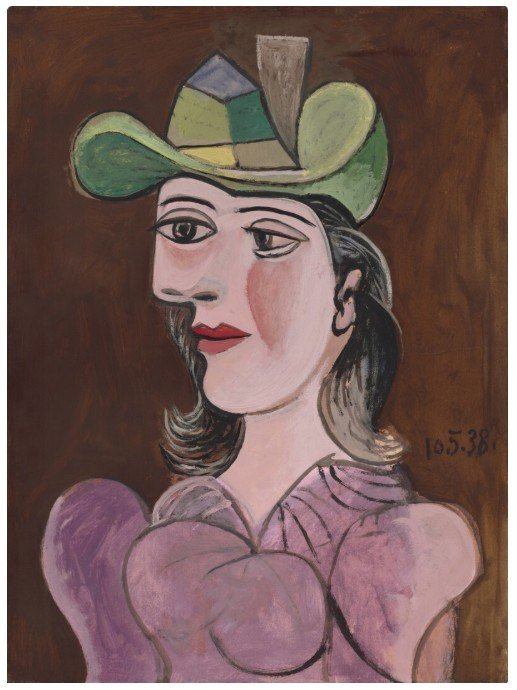
"This portrait masterfully employs fractured planes and simultaneous perspectives to convey a complex psychological state, demonstrating a confident command of Cubist principles applied to emotional depth. While its deliberate formal tensions, such as the disjunctive facial features and the stark background, create a powerful aesthetic, they also present a challenging, intentionally unresolved visual experience."
Historical Context
Within the Movement
This work is highly characteristic of Picasso's intense and psychologically charged portraits from the late 1930s, particularly those depicting Dora Maar, aligning with the expressive phase of his Cubist-Surrealist synthesis.
Lasting Influence
Its formal execution, marked by bold outlines and direct paint application, is consistent with the artist's confident and often raw approach during this period, distinguishing it from the more analytical rigor of earlier Cubist works by himself or peers like Braque.
Eight-Dimension Evaluation
The figure's central dominance and the interplay of fractured planes create a dynamic, albeit flattened, spatial experience, though the background offers minimal depth.
The limited, high-contrast palette effectively emphasizes key features and contributes to the work's directness, yet the overall tonal range is intentionally narrow, flattening volumetric rendering.
The confident brushwork and strong linework demonstrate a masterful command of the medium, though the visible texture of the paper and the directness of application suggest a less refined finish than some oil works.
The intent to deconstruct and reassemble the human form to convey psychological complexity is profoundly articulated, pushing the boundaries of traditional portraiture.
While building on established Cubist principles, the work takes significant risks in its emotional intensity and the deliberate distortion of features, challenging conventional aesthetic norms.
The immediate impact is powerful and unsettling, creating a memorable and psychologically resonant aesthetic that demands engagement from the viewer.
The work achieves a strong internal cohesion through its consistent stylistic language, though its deliberate formal tensions and "unresolved" features are integral to its conceptual strength rather than a flaw.
This is a fully realized and confidently executed work by a mature artist, demonstrating complete mastery of its chosen idiom and a clear, impactful artistic statement.
Apply the Rubric to Your Own Work
The same eight-dimension framework used to evaluate Picasso is available to every artist who submits through Studio Praxis.
Submit Your Work → Read More Analyses →